


Saturday afternoon at the harbour mouth: a charter boat drifts sideways across the channel, a ferry is already committed to its turn, and two yachts wait with engines idling. Nobody aboard is being reckless. Each skipper is doing one small thing slightly wrong, and in a crowded port those small things stack up fast. The good news is that nearly every incident in a busy harbour traces back to a short list of repeat mistakes — and each one is easy to correct.
Rushing the approach, or crawling into it
The most common manoeuvring error is a speed that leaves no margin either way. Too slow and you lose steerage: a rudder only works when water flows past it, which is why a boat idling into a berth with the tide pushing her beam can become a passenger. Too fast and you have no time left to abort, and your wash starts rearranging the neighbours' fenders.
Find your own number before you need it. On a calm day in open water, throttle back until the boat stops tracking a straight line, then add a little. That is your minimum manoeuvring speed, and it changes with wind, current and load. In harbour, plan to enter at roughly that speed with a touch in reserve.
Two habits help more than any gadget. First, decide your approach side before the harbour mouth — into the wind or current where possible, so they brake you rather than shove you. Second, treat going around again as free. A missed turn costs two minutes; a forced one against a concrete quay costs a season.
Learn your prop walk, too. Almost every single-screw boat kicks her stern one way when you engage reverse, and that kick is a tool, not a nuisance. Find the direction on a quiet afternoon and use it to swing the stern toward the pontoon instead of fighting it with the wheel.
Talking to the port: radio habits that prevent trouble
In a busy harbour, listening is worth more than transmitting. Before you call anyone, spend thirty seconds on the marina's working channel or channel 09. You will hear who is moving, who is leaving a berth, and which fuel dock is occupied. That silence you were about to fill with a long call is often the most useful information of the day.
When you do call, keep it short and useful: boat name, position, intention.
- "Blue Marlin, Blue Marlin, entering the harbour mouth north side, requesting a berth assignment."
- "Blue Marlin approaching the fuelling quay from the east, will wait clear of the channel."
Say what you are doing, not what you are thinking. Avoid long narratives, avoid chat on the emergency channel, and switch to the telephone for anything administrative — berth bookings, bills, spare parts. And do not assume that radio silence means clear water. If nobody answers, slow down and look out of the window rather than pressing on because you announced yourself.
Mooring mistakes: fenders, lines and the missing spring
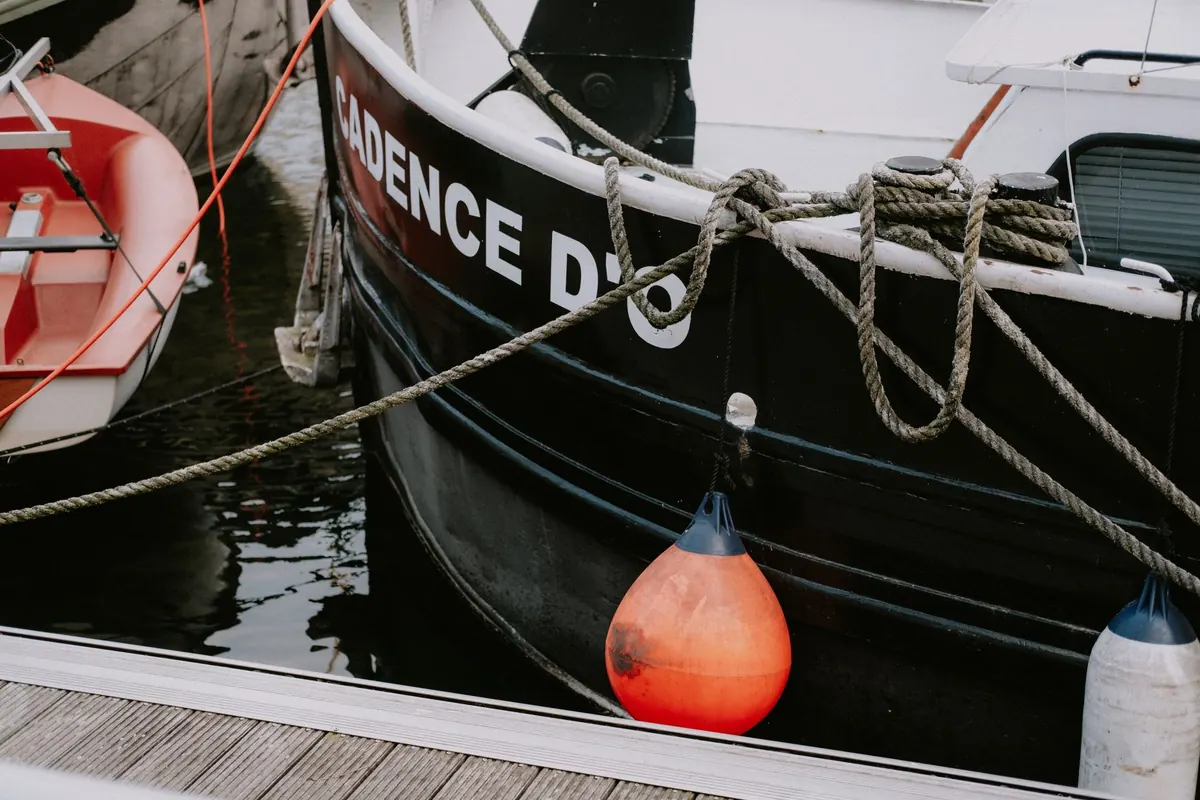
Mooring goes wrong in the last ten metres, usually for lack of preparation in the previous ten minutes. Lines should be rigged and fenders hanging before you enter the harbour, not while a crew member kneels on the foredeck threading a rope through a fairlead.
Three faults show up again and again:
- Fenders too high or too few. They should sit at the widest part of the hull and at the height of the pontoon edge, tied to a strong point — a stanchion base or a toe rail, never the top rail, which bends under load.
- No spring line. Bow and stern lines hold you to the dock; a spring stops the boat sliding fore and aft. It is the line that lets you settle a restless boat by easing the engine against it in gear.
- One line, one cleat, no turns. A single loop will slip. Take a full turn and finish with a proper figure of eight, and make sure the line leads fair so it does not chafe on the quay edge.
In Mediterranean ports, stern-to berthing adds its own trap: dropping the anchor on top of the lazy lines. Motor out well beyond the berth, lower the anchor deliberately, and keep gentle tension as you reverse. Confirm which line the dockhand is throwing before you take it, and keep the engine running until everything is fast.
Right-of-way: who actually goes first
Skippers often carry a simplified version of the collision regulations in their heads, and busy harbours punish that. In a narrow channel, keep to the starboard side of it and do not impede a vessel that can only navigate safely inside it. A ferry, a tug with a tow, a dredger or a fishing boat working its gear is not being pushy; it simply has nowhere else to go, and it cannot stop on request.
Where the rules give you the right of way, use it clearly rather than stubbornly. Holding a course with a beat of hesitation is what confuses other skippers. If you must alter, alter early and obviously, so your intention reads from a hundred metres away. Sailing vessels generally give way to power-driven ones, but that flips in narrow channels, when overtaking, and when the other vessel is restricted. Local port regulations override everything — read the harbour's own rules once, properly, rather than guessing from what a friend does.
Briefing the crew — or not
Most shouting in a marina comes from unclear roles. Thirty seconds before the harbour mouth, agree who does what: bow line, stern line, fenders, radio, and one person whose only job is to keep the helm informed about distances. Nobody jumps for a dock; a fender between the hull and concrete does the work. Keep hands and feet inside until the boat is stationary and made fast.
Small habits with outsized consequences
Wake is the quiet offender. In a no-wake zone, your wash is somebody else's mooring problem: it lifts tenders, strains lines and rolls drinks off tables two pontoons away. Ease off early rather than at the sign. Never anchor in a fairway, in the turning basin, or in front of the fuelling quay because it is convenient for five minutes. And if you have touched bottom or picked up a line, check the propeller and shaft before engaging gear, not after the vibration starts.
Five minutes before the harbour mouth
Run this once, out loud, every time. Rig fenders and lines on the correct side. Confirm the berth and the approach with the marina. Slow to your minimum manoeuvring speed. Brief the crew and clear the decks. Listen on the working channel before you press transmit.
None of it is difficult work. It is just work done early, which is the whole difference between a pleasant arrival and the story everyone on the pontoon tells afterwards.
Photo: ela dalgın / Pexels
Related posts
More stories you’ll love reading